General News
5 September, 2025
Residents urged to prepare for fire season early as increased risk flagged locally
An increased fire risk has been predicted for Victoria’s central and south west regions this spring, with locals urged to plan far ahead of the upcoming bushfire season.
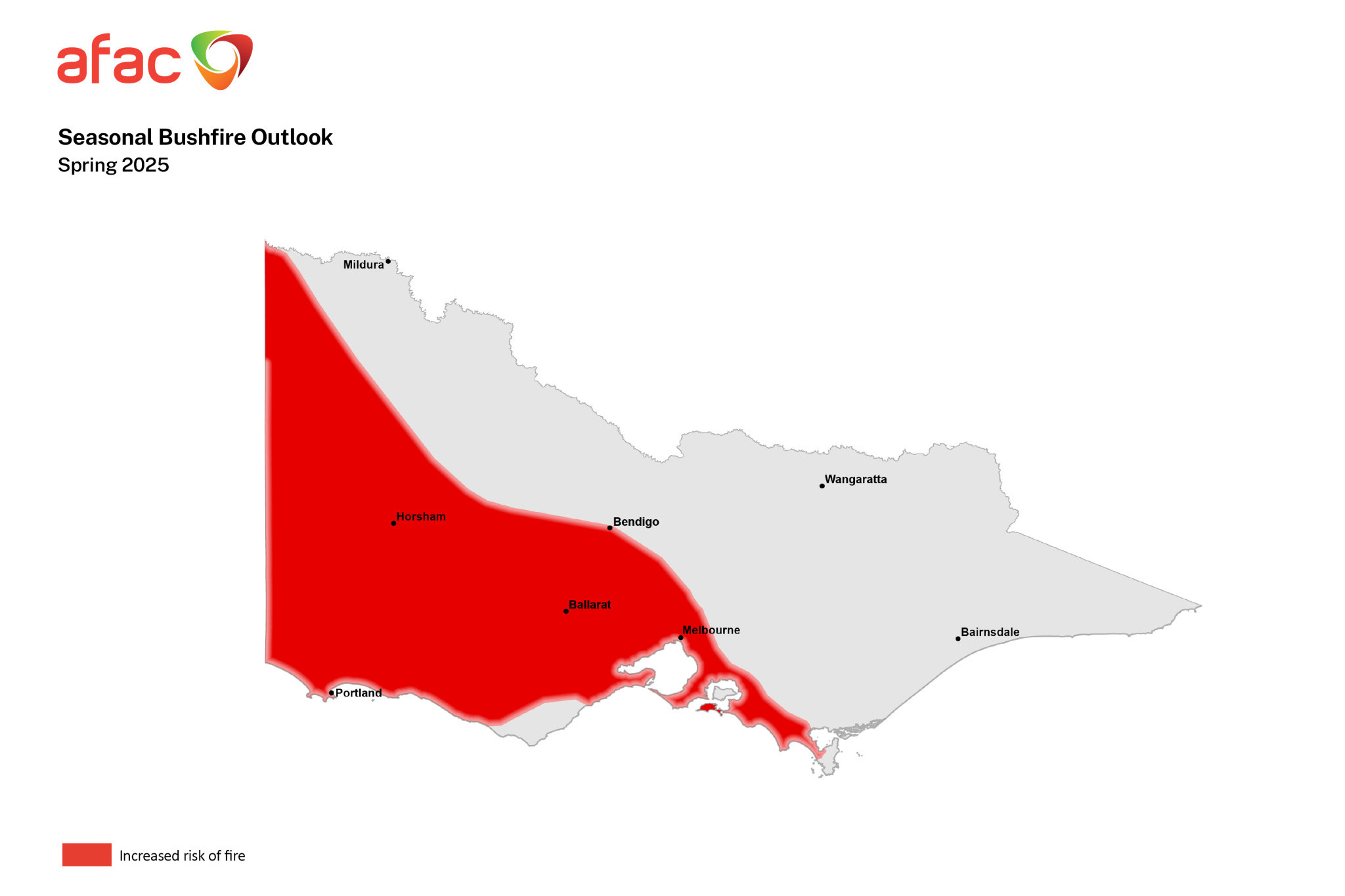
According to the Australasian Fire and Emergency Service Authorities Council (AFAC) seasonal bushfire outlook, Victoria has had the lowest 18 month rainfall on record, with deficits persisting across the west and central parts of the state.
This has also expanded into the north central and central highlands.
These areas have a significant accumulation of dead plant material and have the potential to heighten significant bushfire activity.
According to AFAC, Autumn was very dry across Victoria, but substantial rainfall occurred in June and July with notably heavy falls in the south-west and central parts of the state. Forest fire potential is likely to remain suppressed through early to mid-spring but a lack of spring rainfall could see underlying dryness rebound quickly, driving a rapid shift to above-normal fire potential in late spring and summer.
As a result, despite recent rainfall, above average fire potential is still expected for drought affected areas in Victoria, mostly later in spring.
Goldfields Group Officer Peter Higgins agrees the combination of remaining vegetation and recent weather conditions present an increased fire risk for the Central Goldfields.
“We also have a lot of areas around here that haven’t been burnt. Last season we had a couple runs around here but the fire season you miss just puts you closer to the one you will have,” he said.
While the area has finally seen some rainfall in recent weeks, Mr Higgins is also concerned local dams and bodies of water are still low for the time of year.
“The biggest problem we face at the moment is there are a lot of dams that are empty. But even at Tullaroop, Cairn Curran and Laanecoorie, those bodies of water are all reasonably low for this time of year,” he said.
“Another consideration is if we are fighting a fire and we’re having water drops with helicopters, instead of the usual turnaround where they would normally just fill out of a dam, they may have to go back to those large waterways, so they’re gone off the fire ground for a lot longer than normal. They’ll give us a drop of water but we may not see them for another five or six minutes.”
He believes most areas throughout the Central Goldfields have this risk.
“There are still chances of running grass fires between here and Moolort or Natte Yallock, or out to Dunolly or Talbot,” Mr Higgins said.
In preparation for these conditions, he is strongly advising the community to clean up their properties and ensure their fuel levels are low.
“Get your fire prevention done now. Don’t leave it until it becomes too big. Do it now,” Mr Higgins said.
Ahead of a looming fire season, a recent CFA survey revealed 40 percent of Victorians living in bushfire-prone areas do not have a bushfire plan in place to save their family.
Despite the AFAC indicating increased risk across the state, the CFA’s post-season bushfire survey found out of the 611 people interviewed, 24 percent did not feel adequately prepared around their home. One in five people in these areas said they do not believe “leaving early” in a fire emergency is the best way to safeguard their loved ones.
Over the last two years, the survey has shown the perception of a bushfire being a threat to Victorians and their property has declined from very large to small, with 50 percent of people not showing concern and nearly 40 percent not alarmed enough to warrant direct interaction with CFA. Those least concerned, and less likely to be prepared were located just 500 metres to one kilometre from bushland.
CFA Chief Officer Jason Heffernan expressed his concerns about the distressing statistics, warning Victorians that now is not the time to be complacent.
“It is never too early to prepare. Don’t gamble with your safety this season, residents living in high fire risk areas must take their preparation more seriously,” he said.
A further 31 percent of respondents said they would delay leaving until threatened by a bushfire, waiting for the danger to increase or for instructions from emergency services.
“It is vital you understand the risks of your residential area and where you are travelling this summer. The best way to do this is to download the VicEmergency App and set your watch zones. Don’t wait for an official warning before you take action to protect your family,” Mr Heffernan said.
In response to these figures, Mr Higgins is also urging locals to start being more aware and proactive, believing the cold season has lead people to neglect these procedures.
“It’s been cold and it’s been wet, but even if your fire plan is just an update, have the conversation with your neighbour about what happens if the fire is in your street,” he said.
“Most of the people in your household who might know fire plans are your children. They are taught it at school, so have the conversation as a family and get your fire plans going while you’ve got the chance.”
Mr Higgins advises there are numerous actions locals need to consider in the event of an emergency.
“On the days where there is fire in the area, your safest friend is your letter box. If an emergency gets going, please stand there,” he said.
“We have gone away from the old ‘on bad days, keep your blinds down’ I’d like to be able to see what’s coming at me.
“Work out your escape route, have more than one. Ask yourself ‘have I got all my valuables? Have I got them on a USB stick or in a container?’ Your bank books or photos, it is better to have them now, than try to find them when it hits the fan.
“At the end of the day, you can always build another house, it is very hard to replace life.”